Saturday, March 26, 2011

Buenos Aires

Without any complicated process to take care of, we were in a taxi and on our way to our downtown hotel in Buenos Aires fairly quickly. The name translates as "good air", and in fact we could see the aiport from 50 miles away, and there is no pollution haze, thanks to the sea breeze.

Our ride into downtown BA took us past some substantial slum areas on both sides of the freeway, with what appeared to be squatter houses built up out of various types of scrap. Some were multi-story, some built on to bridge and overpass piers, and some had penthouse verandas. We learned later that they were immigrants ( we were told that most were from Paraguay). There are said to be large numbers of illegal immigrants living and working in the area, and we did see what looked to be a level of tolerance for people living in parks, sleeping on sidewalks (with mattress and bedding). Live and let live.

As it happened we arrived in BA on a national holiday, and most shops were closed. Walking near our hotel, we came upon a large stage, with barricades and preparations for some kind of major event. We learned that Placido Domingo had chosen BA for a 50th anniversay performance. It was due to take place at 8:00 p.m., and people were gathering in mid afternoon. Our dinner reservations were for 8:00 p.m., and after consulting with the concierge at our hotel, we decided to give it a miss. He said if we did go, leave all jewelry, wallets, watches, etc. in our room, as the area would be full of pickpockets. As it happened, the paper said that 120,000 people came out, so we would have been listening to speakers blocks away anyway. The concert took place on Avenue of 9 July, said to be the widest street in the world. It may be, as there are about 4 lanes of traffic in each direction, and a very large middle boulevard, with parks and monuments, along the whole length.
The next morning we had a three hour guided city tour. Our guide turned out to be a very interesting fellow in his own right. A lifelong Buenos Airean, now 60ish, he had trained as an architect with no desire to be one (didn't like the construction industry). He worked a bit in a small family owned publishing company, and wrote short stories, and finally a few books. He said that one, about the Titanic, had some success due to fortuitous timing, coming out at the same time as the movie and a major Titanic exhibition, and he also wrote by request a follow-on childrens' book on the subject. His subsequent book on the Concorde didn't recover expenses, and he's currently writing one on the 747. He was a fountain of knowledge and strong opinions on local history, culture, and politics.
He took us first through the area of 19th century mansions, nearly all built in the French style. BA has been called the Paris of South America, for good reason. Much of the upper stratum of society at the time was French, the architects were French, and you can easily imagine walking from many of the streets directly on to the Champs Elysee. Many of the mansions reverted to state ownership over the years, and quite a few are residences for foreign ambassadors. One that was built by its owner as his personal Versailles is now the home of the American ambassador.

Our guide included a visit to the most spectacular bookstore, El Ateneo, we will likely ever see, although he told us it is rated #2 in the world. It is a former theatre,beautifully renovated. You can sit in one of the old boxes or balconies and read and browse, enjoy a beverage in the orchestra pit, or just buy books from the very extensive collection.

Our first full day in Buenos Aires ended with a visit to a Tango show. Tango is a national passion. The show was presented in a theatre dedicated to Carlos Gardel, considered the best Tango singer ever. He died in a plane crash in 1935 at the age of 45. The show had a variety of well staged individual and group dance acts, Tango singers, and orchestral performance (three button accordians, two violinists, a bass fiddle and a piano, on a stage elevated above the dance floor. Drinks and appetizers were served. It was an interesting experience even for gringoes, but I wished I understood the language to appreciate some of the nuance.

The cast taking a bow at the end of the show

The next day we had a liesurely breakfast and then went for a long walk. We started off in the reconfigured 1896 docks area. It was more or less abandoned for some years, then became the object of a renewal effort. It now hosts restaurants and offices in the old warehouses, and luxury apartments and shops accross the water on the other side. There is a large nature reserve between the residential area and the Rio Plata (River Plate).

The rehabilitated docks area
We continued, walking for a total of about 4 1/2 hours, through different parts of the old and new city, then back along a boulevard near the docks where I'd run in the morning and saw the food vendors setting up in the rain. By now the weather was sunny and warm, and the area was crowded with people eating, drinking, meeting and enjoying their Saturday. One think we hadn't seen before was the local biker gangs. These were groups of early teens with highly modified bicycles. The mods were for style rather than practicality, and showed some mechanical ingenuity.


Low riders with lots of spokes are hot
Some were equipped with loud speakers, blasting the choice of music to the world.  We also discovered a new way for a couple of pillowless folks to enjoy a comfortable rest on a concrete bench.

Head to head, resting on each other's shoulder

We continued with a detour through the nature reserve, and then on home, with a brief stop for some bagpipe practice.

Why we don't stay long in one place

Back to our hotel, and after dinner at a local restaurant, off to bed.

In the morning, we checked out of the hotel to head back for San Fernando airport and the next stage. It was a short but intriguing visit to this major city of about 12 million people. Will learn Spanish before the next visit.
El Ateneo bookstore

We passed through several very nice squares with monuments to important personages in Argentine history. One commemorated the life and battles of Jose de San Martin, the faterh of Argentine independence, who was involved in the overthrow of the Spanish viceroy in 1811, and participated with Bernardo O'Higgins in similar enterprises in Chile, Peru, and Bolivia.


Monument to San Martin (background)

We continued into the older part of town, the Boca (the word meaning "mouth", and the mouth of the river). This was the 19th c. port area, and at the time it was populated by Italian immigrants. They built cheap housing out of corregated iron. Lacking money for paint, they used leftovers from ships' paint, and this is said to be the origin of the brightly coloured and varied appearance of the houses.

 Now it is the Tango district, with lots of small restaurants and food stands, hawkers, street perfomers, and tango dancers who will invite you to join them for a lesson. We were, of course, on a tour, so couldn't participate. Our guide told us that although it has the appearance of a tourist trap, local folks do enjoy visiting at times of the week when there aren't so many of us.

We visited the Recoleta cemetery, which, like New Orleans, has crypts and mausolea instead of graves. Some were very extravagantly styled, with room for generations of corpses. Quite a few were abandoned and not maintained, with deteriorating caskets sitting on the shelves. We finally arrived at the star attraction in the cemetery, the Duarte family crypt wherein repose the remains of Eva Peron, Argentinia's and Andrew Lloyd Weber's Evita. She died of cancer in 1952 at the age of 33, and has been the subject of controversy ever since. Her body was secretly transported to Milan during a period of "de-peronisation", but after fourteen years there and a couple of years on the dining room table of Juan Peron and his third wife, it was returned to BA and the bizarre journey ended with entombment in the family crypt.

The final (or at least current) resting place of Eva Peron

Friday, March 25, 2011

San Carlos de Bariloche, Argentina

We left Puerto Natales airport late morning for the 700 nm flight to San Carlos de Bariloche, our port of entry into Argentina and location of our home for the next couple of nights the Llao Llao hotel in the Nahuel Huapi National Park. The flight was unremarkable except that we had to carry it out at FL 300. Our aircraft was hit with an airworthiness directive restricting our altitude, due to a very small number of instances of engine surges caused by carbon buildup in the combustion area of the engines. The engine manufacturer (Pratt and Whitney Canada) has developed a fix, but it will be some time before it can be implemented, and the Federal Aviation Administration's interim solution is to restrict our operating altitude. This is unnecessarily conservative in the view of PWC, the aircraft manufacturer, Transport Canada, and certainly all the operators, but we're stuck with it for the moment and it means increased fuel consumption and reduced speed and range.

Clearing customs at Bariloche was reasonably straightforward and our van picked us up to take us to the hotel (pronounced "jhow jhow" in Argentine Spanish, vs the "yow yow" the double l would normally yield). A night at this fabulous hostelry is apparently among the "1000 things to do before you die" listed in the book of the same name, and we concur.

View of the Hotel Llao Llao

Our hotel was a few km. beyond Bariloche, and our driver gave us an impromptu tour of the town on the way. It has a population of about 150,000, having more than doubled in the past few years. The main industry is tourism, including skiing in the winter, and it has a definite European alpine look to it, not surprising as there has been a Swiss "colony" for about five generations, and there were a number of German immigrants following WW II. There are several chocolate shops, and another small local industry is production of rose seed oil, supposedly a skin rejuvinator, and rose hip tea. The roses were brought by immigrants (I believe I was told English), and have spread into the wild.

The town is in the national park, and although land in the town can be privately owned there are developmental and architectural restrictions, so the rapid growth has caused some stress. Passing by the civic centre, I noted that the log-built police station had a burned and blackened look, and our driver told us that there had been a shootout between the police and a criminal gang some months previous, one of the gang being killed, and the gang had retaliated by coming into town and firebombing the police station - something our Banff RCMP don't have to deal with.

Soon after our arrival at the hotel, Brenda felt the need for a bath.

View from the bathtub

I thought she hadn't smelled too bad before, but what do I know?

A bit of repose on the balcony, then another fine dinner. In the morning we went on a tour with a local guide who showed us the sites (many of which were different views of our hotel) and some of the local flora including the trees (Lenga or Nire) that host the Llao llao fungus after which our hotel and the area are named. They cause a bole to grow on the tree and the spherical mushroom-like fruiting bodies  were valued by indigenous people. The name translates as "yummy yummy".

Our tour included a trip up a small chairlift about 350 m. above the valley, for more great views.


View of the area from the top of the chair

The afternoon found us both feeling the need to burn a few calories, having stoked up pretty generously over the previous days, so Brend went for a hike on one of the local trails, and I found a small mountain to run up (Cerro Llao Llao, actually).

Cane bower along Brenda's trail

We both felt better overeating at supper time.

In the morning, back to the airport to clear outgoing airport security, deal with landing and parking fees, etc. It was about an hour or more of round and round and up and down, but finally back to the airplanes, and on our way to Buenos Aires, FL 290 away from the Andes and Pategonia and over the Argentine steppe and the pampas. The latter looked very much like the prairies in springtime. Distance was about 720 nm., which in our reduced circumstances was about 2 1/2 hours. 

Monday, March 21, 2011

Santiago, Puerto Natales and Torre del Paines, Punta Arenas

Back to Santiago for two nights. After arrival at our hotel, which was swarming with clean cut young men in dark suits, referred to by other young folks as "sir", apparently in anticipation of an upcoming visit by an important international leader, we went for a short walk around the neigbourhood.
We had a city tour arranged in the morning in Santiago, and our guide started off with a drive to the downtown and central square area. One item of interest is a special style of coffee shop, with darkened windows. This is where one (generally a male one) goes for coffee "with legs". The legs are attached to attractive and minimally clad young women, who will stand around and chat. The price of the coffee (not including tips) is less than Starbucks. There were a number of these places, apparently catering to the ethnicity preferences of the patrons.

In the main square, the Plaza d'Armas, a couple of our number were accosted by a 20ish girl in shorts and tank top, with strange markings on her hide and a rather gamy smell. She was looking for money, but wasn't persistent. We witnessed the encounter and asked the guide what it was about. She told us it was a university freshman initiation ritual, wherein the victims were doused in foul smelling preparations and sent out to raise an amount of money in a short time.


Some new friends, who said they could arrange budget accomodation

Some of the historic buildings in the square still bore earthquake damage from  Feb. 2010, but we were able to visit the Catedral Metripolitana, a 19th century building with beautiful frescoes.


 Many of the buildings had a distinclty French republican look to them, as French architects were very much in local favour during the 18th and 19th centuries.


Main post office, Santiago, Plaza d'Armas

Santiago is a city of about 7 million people and as the perceived centre of economic opportunity for Chileans through the years. It is now home to around 40% of the country's population. The setting, with its hills and with the Andes in the eastern background, is beautiful. The pollution generated by the activities of so many people, and the local geography mean that the air quality suffers, and we were told that winter inversions make it so poor as to cause respiratory problems, particularly among children. Among the efforts to mitigate are a number of very nice parks, including one near our hotel with good running and walking paths, an equipped public outdoor exercise facility, and a couple of aviaries.
As always, just a taste (including a pretty good taste of Patagonian King Crab for supper), then onward and upward.

Morning meant departure for Puerto Natales via a fuel stop in Puerto Montt. FL 350, and nothing exceptional other than our first significant clouds. We were in tops for a while, then on top, the only effect on the flight being to spoil the view of the ground including some of the nice peaks of the Andes. Temperatures aloft, which have been warm at about -44, started to drop just north of Santiago, and now they are at a more normal (for us Canucks) -55 C. or so (in other words ISA). This makes some difference to our flight, as jet engines are able to produce more power at lower temps., so we can get a bit more speed if we want.  Puerto Natales is at about the same south latitude as Calgary is north. We're here one night before moving on to Torres de Paines National Park. Puerto Natales appears to be a gathering spot for young adventurers and trekkers wanting to experience the wilds of Patagonia, so lots of budget accomodations and neat restaurants. The locals are much more obviously comfortable in weather that would send other S. Americans scurrying for cover, and the place has kind of the look and feel of a Canadian town of the Maritimes.

At the road entrance to the town there is a large statue of an odd looking critter the size of a very large bear, but with a thick muscular tail and the head more like a camel than a carnivore. The road signs in town all have a representation of the same animal. Turns out it's a Milodon, a sloth-like animal that became extinct about 10,000 years ago. A skin and bones of one of these were found in a cave near Puerto Natales by a local settler and rancher in 1896, bringing the region some notoriety,

Up close at the Milodon Cave

After visiting the cave, we proceeded by van to Torres del Paine National Park about 100 km. north, our home for the next couple of days. The Torres del Paine, or Paine Towers is a group of four spires reaching an elevation of about 10,000 feet ASL. On the way in, we passed herds of guanaco (wild member of the camel family, related to the llama), nandu (rhea americana, or South American ostrich)and saw a few grey foxes and various raptors including hawks, eagles, and condor.


Nandu among the sheep

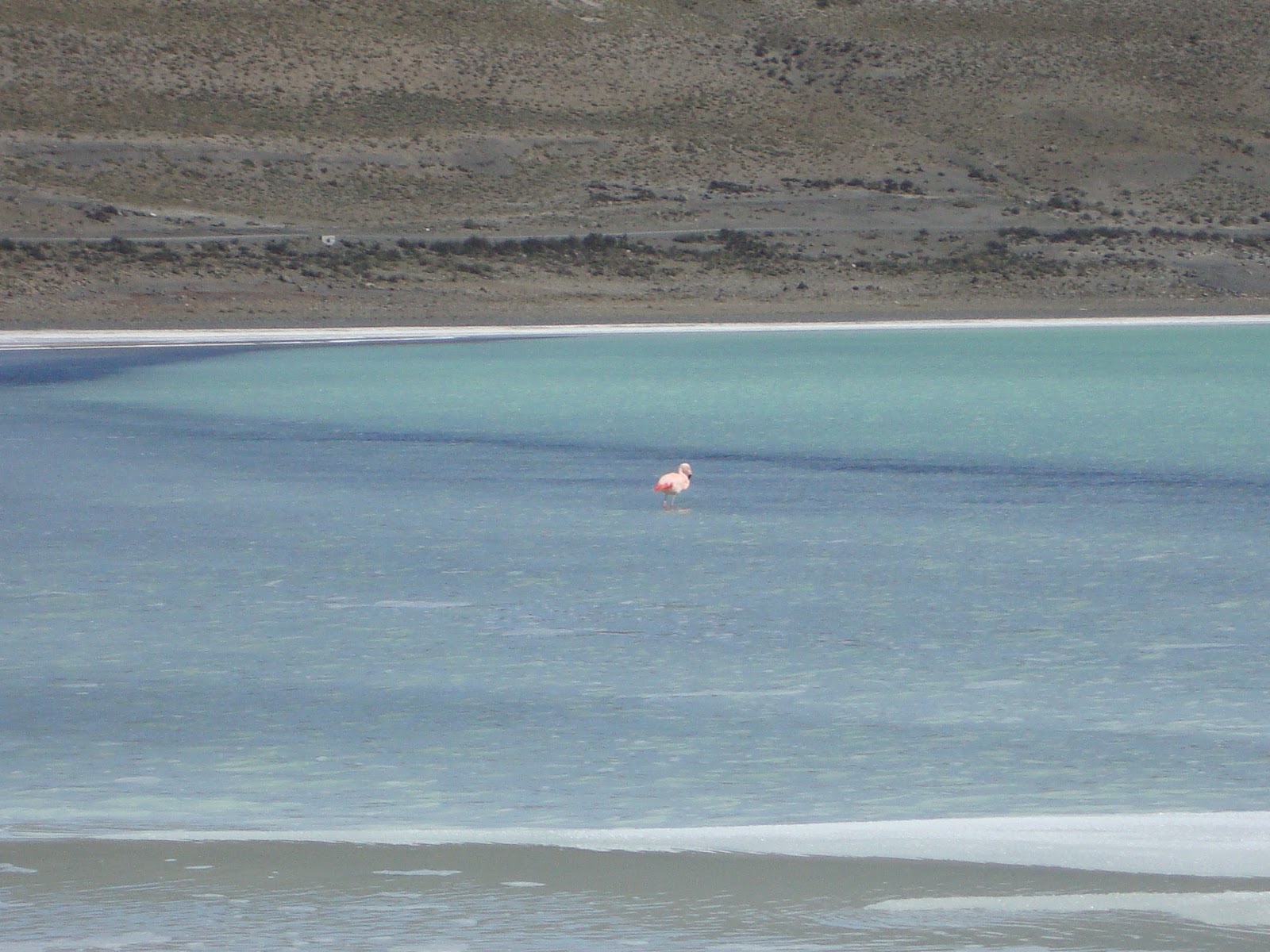
Another curiousity in a highly alkaline (ph 9.1) lake along the way was living, growing stromatolites. Last time I saw those was in precambrian fossils, but conditions at this place make it one of only 2-3 places on the planet where they currently grow. Nobody else was as thrilled as I was. There were also a couple of pink flamingos feeding on brine shrimp


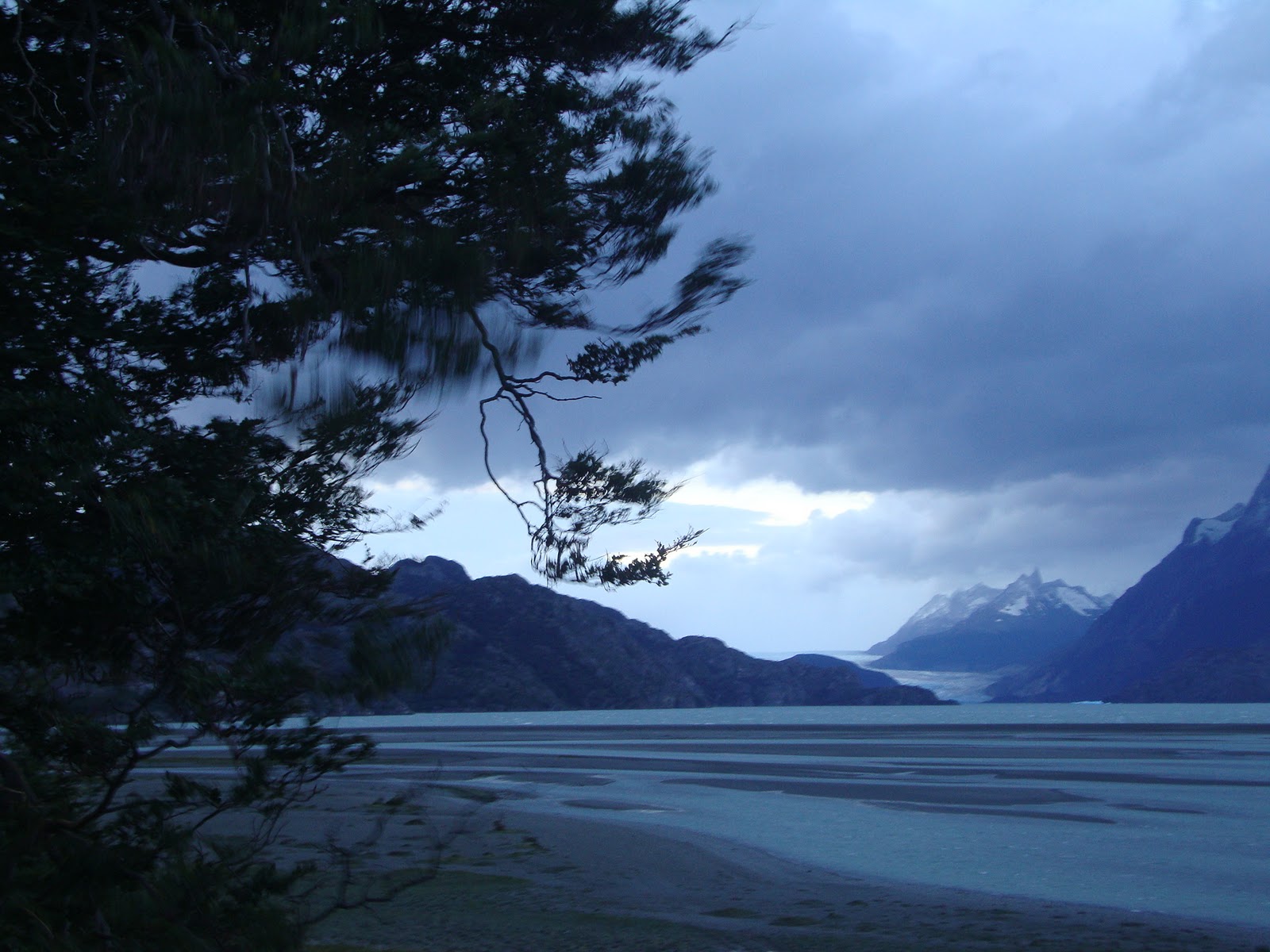
 The park has a number of large, glacier-fed lakes, and our hotel, was named after the body of water adjacent, Lago Grey. We could see the foot of the Grey Glacier at the end of the lake. It's part of the South Patagonian Ice Field, the second largest non-polar ice field in the world. On arrival at the hotel, we went for a stroll along the rocky beach, and then back for more of the gourmet dining that has charactarized much of this trip. Theweather was coolish, about +7C, with very strong winds typical of Patagonia if the lean of the trees is any indication.

A (so we were told) somewhat rare view of the Paine Towers

 In the morning we went for a longer walk up the Pingo Trail to one of the park's back country camp sites and beyond, then along the morraine near our hotel. In the afternoon we took a boat tour on the sturdy looking Grey II (afraid to ask what happened to Grey I) up the lake to the Glacier, through calved bits of ice floating along the way.

View up the lake from the Hotel Lago Grey
Foot of the Grey Glacier (receding, btw, at 40m/year, about 4x recent historical average)

We were served celebratory Pisco sours cooled with glacier ice on arrival at the ice.

In the morning our transport returned to take us to the airport for the next leg of our journey, Puerto Natales to Punta Arenas, on the Straits of Magellan. This was a short hop of only about 100 nm., so we only climbed to about 17,000 feet, then descended to land. The airport is the staging point for many of the flights to Antarctica, so the weather office is geared up for briefings, with observations from many of the various camps on the polar continent.


Punta Arenas airport
 Trivia - Punta Arenas is almost the same number of degrees South latititude as Edmonton is North. they have the ocean, though.

We picked up our taxis to the hotel, which is right on a main square with a statue of Ferdinand Magellan.


Ferdinand Magellan

Magellan was the first European to sail from the Atlantic to the Pacific in November, 1520, and the strait was subsequently named after him. He gave the name to the Pacific Ocean, which he called the "peaceful ocean" because of its apparently calm waters.

We had a brief wander around the downtown area and grabbed a sandwich to tide us over until dinner time. We had arranged a tour to Otway Sound, with the hope of seeing Magellan penguins. Our guide, Phillipe, picked us up at about 5:00 p.m., as the penguins come back late in the day after all day hunting expeditions. To reach the sound, we passed through a very extensive cattle station, by a couple of open pit coal mines adjacent to the national park where the penguin colony is located.

Smooching couple. They mate for life.


Penguin Pavarotti

Where's Harry? Anybody see him land?


Some facts


And the sounds

They're just so darn cute. I know - "don't anthropomorphise - they hate that."

We were at the colony toward the end of their migration, so most of the colony had lef, but we still saw plenty of action. They dig burrows where they spend the night.

After the very entertaining penguin tour, back to town, and to a restaurant recommended by our guide, Phillipe. It turned out to be an excellent choice, with a good range of nicely prepared local dishes including the locally caught king crab. Phillipe and his wife also dined their that night. The restaurant was only about a five minute walk back to the hotel.

The city has a population of around 150,000, and interestingly (at least to me) somewhere around 50% are of Croatian origin, dating from immigration in the mid 19th century. Like the rest of the Americas, this city also hosted immigrants from most other European countries, and the place has quite a cosmopolitan feel to it. Besides extensive cattle and sheep ranching, most of Chile's oil production comes from off and onshore wells in the area, and there is also coal and metals mining in the region.

In the morning, off to Argentine Patagonia.

Thursday, March 17, 2011

Santiago - Easter Island

11 March, we flew from Calama, Chile to Santiago, to overnight before catching the  morning LAN Chile flight to Easter Island. The flight down took us over the western slopes of the Andes, and lots of mining country, with open-pit and hillside mines. Chile is the world's largest copper producer, and most will remember the August, 2010 drama of the rescue of 33 miners trapped underground in a mine in the Atacama desert. The mountains are very pretty, with lots of colour in shades of red, purple, yellow, green, grey and black according to the mineral constitution. Most of what we overflew was well above tree line, so the colour was all rock.

Mountains north of Santiago, Chile


Arrival in Santiago was uneventful, but we did have an issue to deal with. Our air conditioning had failed leaving Iquique a few days earlier. We met another owner of the same type of aircraft who lives in Santiago, and as it happened he and a partner had a maintenance computer, which is required for some types of repair. In our case, we figured the problem was stuck Vapour Cycle System doors, which open to provide ventilation to the condensor when the AC is operating. The repair would require unsticking the electro-mechanical actuators, and re-calibrating the door positions. After discharging passengers and baggage to the neaby airport hotel, The tour Guy and I did a short low-altitude flight across the city to the little airport where the computer owner parked. With the help of him and his crew, we were indeed able to perform the necessary magic to make it all work, and get out the airport before it closed for darkness. Thanks, guys! Another demonstration of the supportive aviation community.

Supper and sleep at the airport hotel, then in the a.m. walk across the street to catch the Easter Island flight, which we had been told was delayed :45 to 10:45.  Accordingly we dallied an extra half hour before heading for check-in. to be told the flight was closed. Apparenty you must check in by the time required by the scheduled departure, not the delayed one. After some pleading and explanation we were allowed to proceed, and all went well other than some seat-assignment glitches. The flight is about 4 1/2 hours into the South Pacific, and Easter Island (so named by the Dutch captain who "discovered" it on Easter Sunday, 1722) . is about as far as one can get from a mainland continent. Our accomodation is another Explora resort, the Explora Rapa Nui.

Arrived at the airport at Hanga Roa, the major settlement  on the island of Rapa Nui, and were met and hung with leis by the staff from the lodge, then transported to our home for the next few days. The lodge has a central wing with dining, bar, and lounge areas, and two wings with accomodations. Philosophy is similar to Atacama, but the place is much smaller, with room for perhaps 60 or so. We felt like the only guests during our stay.

We did our first tour shortly after arrival, with a hike to the "cliffs and caves". This was our introduction to the cultural history and geography of the island, with our guide, Gina. Fist stop was a restored Moai (the famous stone statues), with seven of the megaliths standing on a platform.

The seven Moai at Ahu Akivi, Easter Island

The original settlers are thought to have arrived on Rapa Nui sometime between 700 and 1300 AD, from other Polynesian islands. The Moia are thought to be representations of revered ancestors, erected overlooking the habitations of the living to provide protection and guidance. Originally they were fitted with eyes of white coral with obsidian pupils, but most of these were removed and the statues toppled during civil wars between the 16th and 19th centuries. The population of the island is thought to have numbered as high as 17,000 or more at one time, but overpopulation and probable environmental change, including erosion caused by deforestation, made the population unsustainable, and civil strife ensued. The megalithic ancestor worship culture changed to a more spirit based (MakeMake) cult in the 16th. century. The new order included the "Birdman" cult, whereby the leader or spiritual conduit was chosen through a vigorous competition carried out among representatives of the contenders. They had to cliff dive, swim, carry an egg... Our visit and learning time was short, and unfortunately much of the oral history was lost by depradations in the 1860's, including slave raids, smallpox, tuberculosis, etc. when the population of less than 5,000 at the time was reduced to only 111.

 Our walk continued along the cliffsides, where we saw remnants of the old population, including foundations for houses, greenhouses (no glass, rather just protection from wind and salt spray), chicken houses (chickens were the primary meat source, and the stone houses were completely closed structures, with only one small hole for the chickens to enter for sleeping at night. No weasels or other predators), lava tube caves, with openings to the seaside cliffs, and lots of horses and cattle. The human population currently numbers about 5,000, and were were told that the equines number about 6,000. Most carry brands, few or none are gelded (lots of foals), and they largely wander free, grazing on grasses between the basalt boulders, and occasionally falling to poisonous lupins or collisions on the roads. (The corpses, of which we saw several, are dealt with by park rangers, who ignite a tire on the remains to burn it. The island has no predators or scavengers other than the introduced rats and subsequently introduced rat-eating hawks.)

A couple of the free-range horses. None are fat.


Cliffside exit from a lava-tube cave

The walk continued to a park in Hanga Roa, and the traditional post-hike snack. In this case, fruit, juice, cheese, and champagne to enjoy while watching the sun set.

All hikes should end thusly
Goodnight, John-Boy

One could be excused for feeling that a day that started in a big-city airport hotel and ended on an Easter Island beech stretches the space-time continuum. We're coping as best we can.

Our next morning experience was a snorkelling trip from Hanga Roa. The wind was up and the water a bit rough, so we didn't venture too far up the coast or to the small islands nearby. The water is very clear, but very low in the plankton and other feed at the bottom end of the maring food chain, so there is not a great range of colourful fish as found in some subtropical waters. Very enjoyable nonetheless. We headed afterward back to the lodge, while our air guide stuck around for some surfing.

Our feerless leaders

The afternoon venture was a trip to the Ranu Raraku volcano quarry site, where most of the moai were carved (from volcanic tuff, using harder basalt tools). The options were to go by van, or bike, so... A couple more guides had the pleasure of our company. The lovely young lady that guided us out ceded the return trip to Gina, who was accompanying Brenda on the van/hiking access to the site. We all met up at the small crater lake, which is now used for a local triathlon event, involving constructing reed boats, paddling them across the lake, carrying them back around, then swimming across.

Over 900 moai were carved between approximately the 12th and 16th centuries. They were carved in place, leaving a "keel" along the back, which was then the last part excavated so as to remove the complete statue. Some partially carved statues are still in place, including one of about 19 metres in length. Many statues were left standing near the quarry  during the period of toppling, perhaps because they were not yet serving their protective function. There is some variation in style, according to period, but many are remarkably similar.


Moai on the hillside of Rana Raraku, watching over alien visitors

Local tradition has it that the statues walked to their platform sites. Alternatively they may have been dragged on wooden structures.

After the visit we proceeded back to the lodge, Andy in trail of a French Guy, and Brenda some distance behind in the van trailing our guide. We enjoyed a pre-supper suana in a thatched structure, with fire heated rocks, lined with eucalyptus leaves by the pool.

The Sauna


...and the pool

A pretty full day, and rounded out by a couple of Pisco Sours (another story), sleep followed.


Our excursion for the last full day on Easter Island was a van/hiking trip to various sites, with lunch on the beach with the other lodge guests. One of our group suggested biking vs. van, so the two of us set out at speed for the first stop, a park near the quarry with 15 moai facing .inland from the sea.


There is also a small cave in the park which is home to a local fellow. He wasn't home at the time, perhaps out fishing. The journey continued with visits to a number of sites with artifacts of village life, and we came across a horse round-up in progress at a small setllement with 3-4 dwellings and a little sheltered bay.


Not sure why the horses were being gathered. We walked by one of the two sandy beaches on the island, and over a ridge to the larger one nearby our lunch spot. It had a row of coconut palms planted by the Chilean navy during their time of administration on the island. Lovely beach, frequented mostly by tourists, and so not by the local folk. Lunch was various grilled meats and fish, fruit, plenty of beverages and all the accoutrements.


We had a short swim before lunch, and rather than going back to the lodge for an hour or so before the afternoon tour, we opted for more beach, swim and sunburn time in honour of the folks back home.

After our swim we headed for the Rano Kau volcano which overlooks the town of Hanga Roa. This is the site of a ceremonial village, Orongo, consisting of 52 stone houses, and a number of petroglyphs related to the Bird Man competition which continued until the sudden population decline in the mid 19th century.

A trip to the handicraft market ended our day, and our brief tour of this very interesting place. We depart the lodge early in the morning for the 8:00 a.m. flight back to Santiago.
 There is also a small cave in the park which is home to a local fellow. He wasn't home at the time, perhaps out fishing. The journey continued with visits to a number of sites with artifacts of village life, and we came across a horse round-up in progress at a small setllement with 3-4 dwellings and a little sheltered bay. Not sure why the horses were being gathered. We walked by one of the two sandy beaches on the island, and over a ridge to the larger one nearby our lunch spot. It had a row of coconut palms planted by the Chilean navy during their time of administration on the island. Lovely beach, frequented mostly by tourists, and so not by the local folk. Lunch was various grilled meats and fish, fruit, plenty of beverages and all the accoutrements. We had a short swim before lunch, and rather than going back to the lodge for an hour or so before the afternoon tour, we opted for more beach, swim and sunburn time in honour of the folks back home.
After our swim we headed for the Rano Kau volcano which overlooks the town of Hanga Roa. This is the site of a ceremonial village, Orongo, consisting of 52 stone houses, and a number of petroglyphs related to the Bird Man competition which continued until the sudden population decline in the mid 19th century.

Tuesday, March 15, 2011

Chile - Iquique Calama, Atacama desert

We blasted off for our flight to Chile, with planned customs clearance and fuel stop in Iquique, then off to Calama for ground transfer to our destination for the next three days, the Explora Larache at San Pedro de Atacama. For those accustomed to private aircraft border crossings in the US and Canada, it's quite a different experience in other parts of the world. We were met in Iquique by a pre-arranged handler, , who was our communication conduit with the customs official who met us and inspected the aircraft, and the assistnat who sprayed the inside with some deadly pesticide. We were required to unload all the baggage, then take it into the terminal for inspection by the regular customs folks, obtain the necessary arrival permission and stamps from immigration, and then pass through security to take our own stuff back to our own aircraft. Having the handler did allow us to bypass some line-ups. Back out to the aircraft to negotiate the refueling, which also is normally pre-arranged. While it is possible to arrange ad-hoc in most places, payment must be in cash. By pre-arranging through a contracting agency, a better price is negotiated, and the bill is sent to the agency and re-billed to us.

In any case, after an hour and a half or so of the preceding, we were taxiing out on the 140 nm. flight to Calama, whose airport is at 7500 ft. ASL. We were met by personnel with a van from the hotel, about an hour's dirve away through a mountain range which helps keep the Atacama desrt the "driest place on earth". There are parts that have not seen a drop of rain in recorded history, and it is spectacularly bleak. Most areas have absolutely no vegetation, and terrrain is a combination of sand, lava flows, and tilted,  eroded, and metamorphosed sediments. As old sea bottom, there is lots of salt and gypsum in the rock, with the gypsum being most resistant to wind erosion.

We arrived at the village of San Pedro de Atacama, which had the appearance of a desert oasis, with trees and greenery, due to a small river fed by run-off from the higher peaks of the Andes to the east. We were privileged to see snow on the volcanic mountain tops (elevation 17-20,000 feet), which is apparently not usual, and resulted from an unusually rainy summer. Our accomodation is in the Explora Larache, part of a Chilean chain which operates in ecologically sensitive areas and dedicates its profits to a parallel foundation which works to study, preserve, and protect. The place is all-inclusive, including tours (hiking, horse, biking, overnight treks) and lectures. Each guest is issued on arrival with a metal water bottle, refillable in the main building. No TV's in the rooms, WIFI only in the lobby and bar, to discourage hibernating. Place has a chain of four infinity pools, each close to 20m in length. Rooms have all the normal amenities of a high-end hostelry, and the meals are first class, with a variety of choices focussing on Chilean food.

The day's activities are booked the night before. Brenda chose a morning hike. Our air tour "facilitator" is a young French man, who in his school years was a competitive mountain biker. He was itching to get out on the desert/mountain trails. When the guides gave a   choice among "easy, moderate, or challenging" routes, the decision was apparently easy, so next morning we saddled up and headed for the hills. Our route took us up a heart pounding climb of about 500 ft. initially, then down the other side and into a basalt rock-strewn desert flat. The morning heat wasn't too bad, although the missing oxygen was noticeable. We had a following vehicle that joined up with  us after the first deser tportion of the journey for a re-stocking of water bottles and some sustenance. We continued along a gravel road that climbed through another pass. Along the road we encountered some folks marking out the last stage of the 265k Atacama Desert Ultramarathon. This is a six stage, six day race, one of a series including the Gobi and Sahara events. The last stage is 70 km. and was being run that day. Our bike route was 60km., and that was quite enough for me. The Frenchman impressed our guide and me with tricks like kicking a rock down the road with his front wheel, long distances on the back wheel, techniques for pushing a competitor off the road, and various unnatural riding positions. We did see more at the beginning of the ride than the end.

In the p.m. Brenda and I went together on a guided hike in the Valley of the Moon, where NASA has  tested a number of extra-terristrial vehicles and probes. Spectacularly bleak, and covered some of the same territory we biked through. It was late afternoon. so we saw some of the race competitors. The first two were about 1km. apart and looked to be in pretty good shape, actually running with perhaps 10 km. to go. Later runners were moving more slowly, but did respond to encouragement from an admirer.

Japanese desert ultra competitor

 The walk continued across hill, desert, and dune, and an old lake bottom that last saw water about 12,000 years ago during the most recent glacial period. It looked about like what some of our shallow Alberta lakes are trending toward.

Brenda and guide hiking across the lake

Near the end of the hike, we stopped on a dune to watch the sunset and enjoy snacks and juice brought by our guide. This is a fine Explora tradition.


Fellow pilot chanting to the setting sun

The next morning's activity was a horseback ride in the desert for a couple of hours. The saddles were Chilean style, a well-padded cross between a western and English style, and english style snaffle bits. (Thank-you Brenda. I know a bit about bike saddles.) Nice horses, but missing their trot-shock absorbers. The ride was fairly gentle, desert and draws. Some of the country would have fit nicely into an old duster.

Desert dune with incongruously snow-capped volcanoes behind

Brenda on her trusty well-padded steed

The Spanish name of my horse translated loosely as farts-a-lot, which gave unnacountable giggles to the woman I live with. We were told later that it also had a reputation for laziness, and during a training exercise with the guides actually fell asleep under its rider. Regardless, the horses are treated very well. After our ride, which would be their only one of the day, they are washed down and placed in luxurious individual box stalls. No scarred nags, these.

Our afternoon hike was the "Cactus Walk" down a canyon with a flowing stream with vegetation. It was a favoured walking route for llama herders in past days, and still showed remains of stone corrals and shelters, as well as some pertroglyphs.

Cactus Walk. The spiny critters can be up to 150 years old and used to be used for lumber.

The end of the walk was again marked with juice and snacks. Our fellow hikers were a mother and daughter from Sao Paulo, Brazil, on an annual vacation away from Carnaval.

After supper in the evening we attended an astronomy presentation, including mapping the southern constellations, and viewing in the hotel's observatory with their 16" reflector telescope. The most memorable part of that event was seeing Saturn's rings in a quartering side view, in exceptionally sharp focus. The sky in the desert region is beautifully dark, the air thin and dry. The area has always been a favourite of astronomers, and is home to a number of international observatorys, including the newest, Llano de Chajnantor Observatory, which when commissioned in 2012 will be the world's largest radio telescope.

Our visit to the Atacama was a signature experience. Our young guides were knowledgeable and attentive, and the region is another of the unique places we are privileged to have visited on this trip. The snow on the peaks was a reminder of what you poor saps folks are suffering through back home.

In the morning, our transfer back to Calama for the flight south to Santiago.